SteamIQ
SteamIQSteam Trap Intelligence

Still Doing Steam Trap Surveys?

See what 90 days of continuous intelligence looks like.

Scroll to read a sample report
SteamIQ
Cascade Manufacturing
Fleet Performance Report
Dec 29, 2025 – Mar 28, 2026  ·  90 Devices
Executive Summary
Your fleet story in 30 seconds
Not a data dump — a financial narrative. Where losses are climbing, which assets are driving them, and what to do about it. Written from 90 days of continuous data, not a single-afternoon walkthrough.

Executive Summary

Your 90-device fleet generated $9,163 in steam losses over this reporting period, with 97.8% of devices reporting. The financial story, however, is one of sharp escalation: monthly losses climbed from $273 in December to over $3,100 in February before easing slightly to $2,914 in March. Five failed open devices and two leaking traps are driving the bulk of this exposure, and the losses are heavily concentrated — Extrusion Line 2 holds 31% of your devices but drives 68% of total losses. A previous repair on Cascade-24 in July 2025 demonstrated clear results — a $1,200 investment delivered 11.4× ROI before a second failure emerged in March.

The most urgent opportunity is Extrusion Line 2, where four devices — Cascade-51 and Cascade-58 (failed open) and Cascade-33 and Cascade-47 (leaking) — are simultaneously degraded, with Cascade-24 on the Steam Header adding the single largest daily loss at $37.56/day. Industry best practices indicate that clustered failures on a single process line often share a systemic root cause — condensate return conditions, supply pressure, or upstream factors — and replacing individual traps without investigating the shared condition risks recurrence. With Washington natural gas prices currently at $14.22/MCF and the fleet still in a seasonal low-demand window, this is the optimal time to schedule a coordinated maintenance visit before steam loads increase.

⚠ Critical Finding: Extrusion Line 2 Cluster
Four devices on Extrusion Line 2 are simultaneously degraded — two failed open and two leaking — combining for the largest share of fleet losses. A coordinated investigation and repair of this line is the single highest-impact action available. Estimated combined repair cost: ~$1,700 with payback in under 45 days.
Fleet Health
Every device, every day
Health score, failure rates, state distribution, trajectory over time. Updated continuously — not a snapshot from the day someone walked the plant.

Fleet Health Overview

Health Score
86.3
▼ 4.1 pts from 90.4
Operational
97.8%
88 of 90 reporting
Failed Devices
7
7.8% of fleet
Period Loss
$9,163
30.1 CO₂ tons

State Distribution

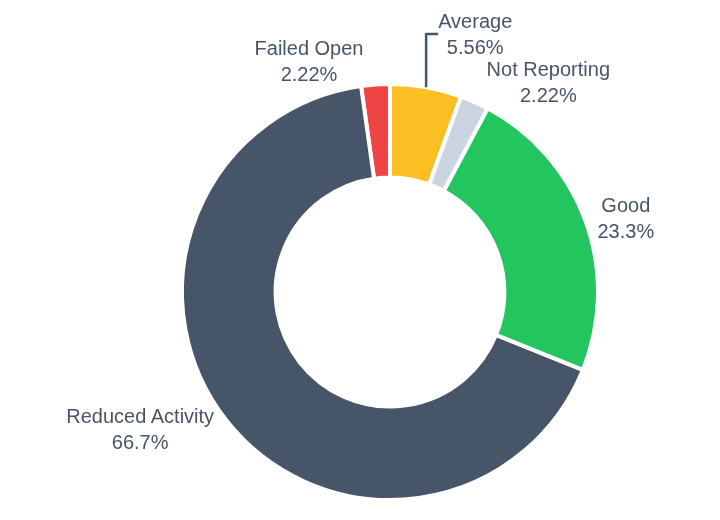
Fleet State Chart
State Count Score
Good 18 100
Reduced Activity 56 90
Average 4 75
Leaking 2 50
Failed Open 5 0
Not Reporting 5 20

Note: The 56 devices in reduced activity are operating normally at low load — this is a healthy state, not a concern. Two of the 5 failed open devices (Cascade-72 and Cascade-77) are also not reporting due to the Cascade Enterprise 3 gateway outage.

Health Trajectory

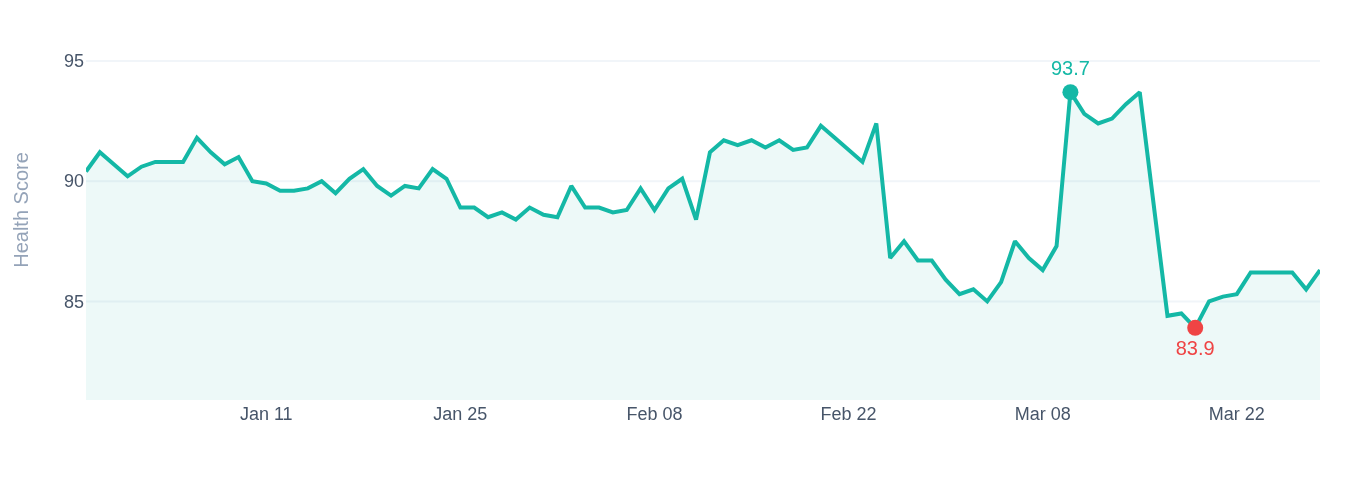
Health Trajectory Chart

The fleet health score opened the period at 90.4 and closed at 86.3, a net decline of 4.1 points. The trajectory tells a more nuanced story: a late-January dip coincided with new devices coming online and the first detection of open failures. A brief recovery to 92.4 in mid-February gave way to a sustained decline through March as the Extrusion Line 2 cluster emerged and Cascade-24 failed for the second time. The Cascade Enterprise 3 gateway outage in mid-March further depressed the score by taking 9 Building C devices offline. The unresolved failed open and leaking devices continue to pull the fleet score down.

Financial Impact
Every loss in dollars, not colors
Monthly trends, asset concentration, and proven ROI from actual repairs. Your CFO can read this. A traditional survey gives you "failed" — we give you "$37.56 per day" and track every repair to measure real returns.

Financial Impact

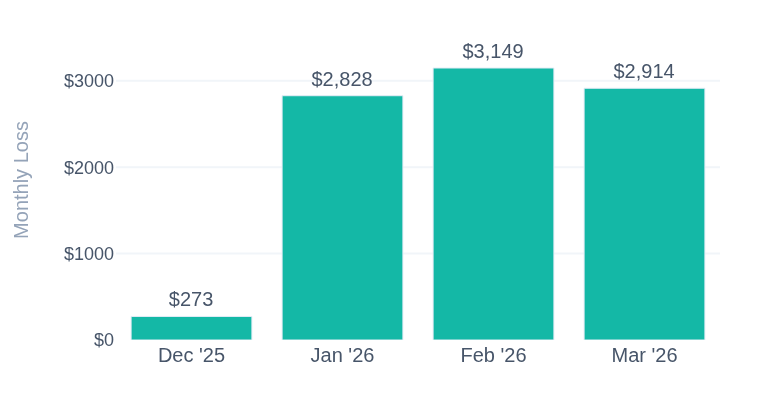
Monthly Loss Trend

Monthly Losses Chart
Month Loss Change
Dec 2025 $273
Jan 2026 $2,828 +937%
Feb 2026 $3,149 +11.3%
Mar 2026 * $2,914 −7.4%

* March includes 28 of 31 days (90.3% of month).

The December baseline was unusually low at $273, reflecting a period before the current failures were detected. Losses jumped sharply in January as the failed open traps came online, then plateaued in the $2,800–$3,100 range through February and March. The slight March decline coincides with seasonal load changes, but the five failed open devices and two leaking traps are sustaining the elevated loss level. Cascade-24 alone contributes $38/day — nearly a third of current daily fleet losses.

Asset Concentration

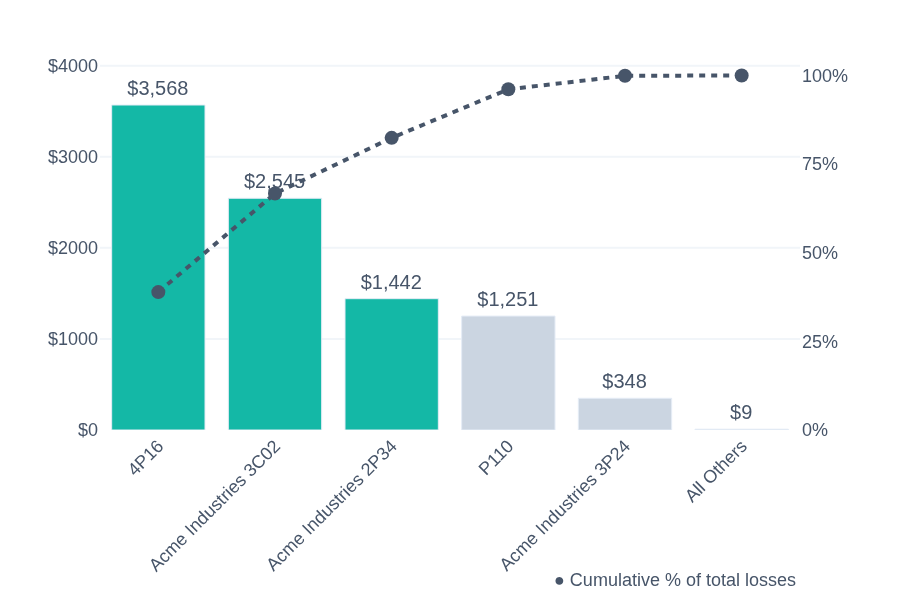
Asset Concentration Chart
Top 5 Device Offenders
Device Asset State Daily Loss Period Loss
Cascade-24 Steam Header Failed Open $38/day $563
Cascade-51 Extrusion Line 2 Failed Open $12/day $136
Cascade-58 Extrusion Line 2 Failed Open $10/day $88
Cascade-33 Extrusion Line 2 Leaking $6/day $62
Cascade-47 Extrusion Line 2 Leaking $5/day $44

Losses are sharply concentrated. Extrusion Line 2 holds 31% of your devices but drives 68% of total losses — 3.8× the fleet average per device. Four problem devices on this line (Cascade-51, Cascade-58, Cascade-33, and Cascade-47) account for the bulk of the exposure. Steam Header runs below fleet average overall, but Cascade-24 alone is losing $38/day — the single worst device in the fleet. The takeaway: addressing Extrusion Line 2 and repairing Cascade-24 would eliminate the majority of your fleet's financial exposure.

ROI Spotlight

Proven ROI: Cascade-24 First Repair (Jul 2025)
Pre-repair loss: $38/day
Post-repair loss: $0/day
Daily savings: $38/day
ROI: 11.4×
Payback period: 32 days
Repair cost: $1,200

This repair kept Cascade-24 healthy for 8 months before a second failure emerged in March 2026. It validates the repair-first approach: a $1,200 investment delivered 11.4× ROI. The same economics apply to the current failures — every day of delay adds to the cumulative loss.

Outstanding repair opportunities: Five devices offer strong financial payback — Cascade-24 at $38/day (32-day payback), Cascade-51 at $12/day, Cascade-58 at $10/day, Cascade-33 at $6/day, and Cascade-47 at $5/day. Combined addressable daily loss from the top 5 offenders: $71/day.

Energy Cost Context
Your gas price, your region
We pull real natural gas pricing for your state from the EIA and compare against national averages. Every loss calculation uses your actual local energy costs — not industry estimates from a textbook.

Energy Cost Context

Washington Industrial Gas
$14.22/MCF
Dec 2025 · $1.78/therm
Year-over-Year Change
+21.5%
vs. Dec 2024 ($11.70/MCF)
WA vs. National Avg
123%
Above national average
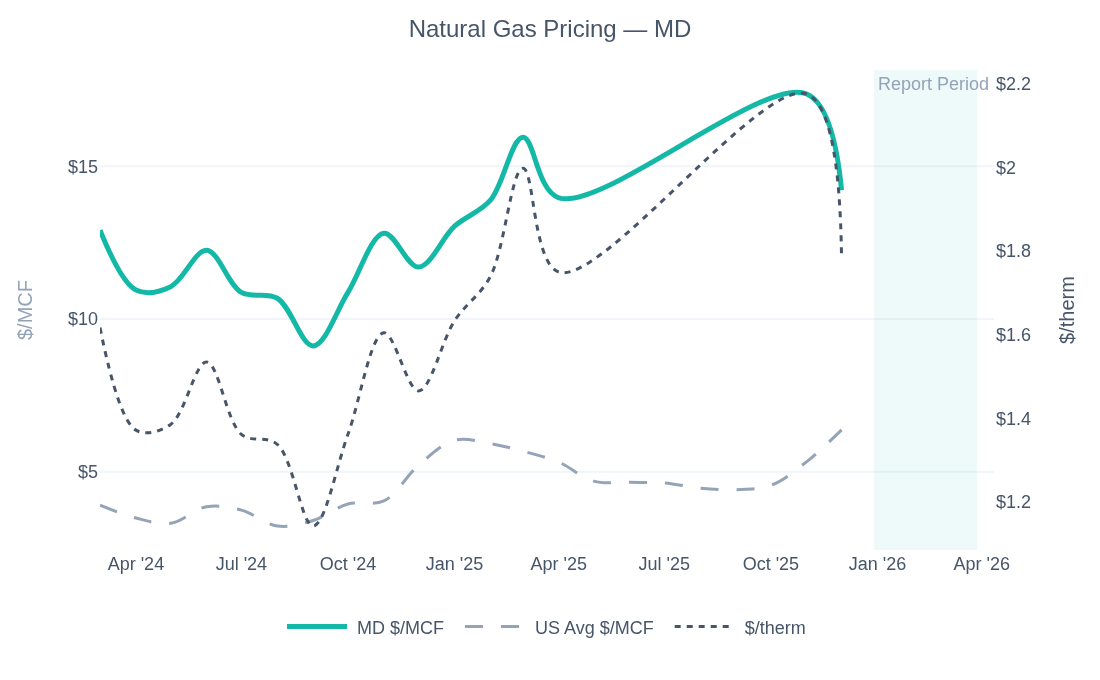
Gas Pricing Chart
Month $/MCF $/Therm Trend
2024-04 $10.95 $1.37
2024-05 $11.06 $1.39
2024-06 $12.25 $1.53
2024-07 $10.87 $1.36
2024-08 $10.68 $1.34
2024-09 $9.12 $1.14
2024-10 $10.87 $1.36
2024-11 $12.81 $1.60
2024-12 $11.70 $1.47
2025-01 $13.04 $1.63
2025-02 $13.89 $1.74
2025-12 $14.22 $1.78

Source: EIA.gov industrial natural gas rates. EIA publishes with ~90-day lag; months after Dec 2025 use the most recent available pricing.

Industrial gas prices in Washington have historically peaked in November and reached their lowest in September — a 65% swing that directly impacts the cost of every therm of wasted steam. Your reporting period (January–March) falls squarely in the high-cost winter window, meaning the current failures are occurring when fuel is most expensive. December 2025 pricing of $14.22/MCF is 21.5% higher than December 2024, adding year-over-year cost pressure on top of the seasonal pattern.

Your currently failed traps are losing 11.6 therms per day. Based on the historical pricing pattern for the next six months, leaving these traps unrepaired would cost an estimated $2,941. The monthly cost would range from $543 in April down to $397 in September as prices follow their seasonal decline — but every month of deferral adds to the cumulative total. Repairing now, while the fleet is in a low-demand period and maintenance access is easier, captures the savings during the months when each therm costs the most.

The pricing trend also reinforces the urgency of the Extrusion Line 2 cluster repair: with gas prices 23% above the national average in Washington, every hour of steam loss through a failed or leaking trap carries a premium cost compared to facilities in lower-cost regions.

Recommendations
What to fix first and why
Prioritized by financial payback, not alphabetical order. Coordinated repairs grouped together. Timing recommendations based on seasonal demand and energy pricing.

Recommendations

Immediate — This Week
  • Investigate and repair the Extrusion Line 2 cluster (Cascade-51, -58, -33, -47). Before replacing individual traps, inspect the shared condensate return line, verify supply pressure, and check for upstream conditions that may be driving all four failures. The line runs at 3.8× fleet average therm rate, suggesting a systemic condition. A single coordinated visit can address all four devices. Washington gas prices historically peak in November — repairing now captures savings during the highest-cost months ahead.
  • Repair Cascade-24 on the Steam Header. This device is losing $38/day with a 32-day payback — the strongest individual ROI in the fleet. Its second failure in under a year warrants investigation of the underlying header condition alongside trap replacement.
  • Restore Cascade Enterprise 3 gateway (Building C, offline 11 days). Cascade-72 and Cascade-77 are confirmed failed open with no current telemetry. Restoring coverage is the prerequisite to dispatching repairs.
Short-Term — Next 30 Days
  • Investigate Cascade-24 recurrence root cause. Two failures in under a year suggests an underlying condition — supply pressure, condensate return, or header-level factors — that simple trap replacement won't resolve. An on-site assessment of the Steam Header installation is warranted.
  • Assess Cascade-47 acknowledged status. This device has been acknowledged but not yet scheduled for repair. At $5/day, continued deferral adds to cumulative losses on an already-stressed line.
  • Assess the 4 devices in average state. These traps show moderate leaks (15–45%) and warrant continued observation to detect progression toward failure before they reach the failed open threshold.
  • Establish a post-repair confirmation workflow. Confirming repair effectiveness within 7–14 days validates the work and informs future prioritization.
Strategic — This Quarter
  • Investigate recurring alarm devices for root cause. Cascade-24 (22 alarms), Cascade-51 (18), and Cascade-52 (15) show patterns that may reflect installation conditions, piping configuration, or upstream equipment state. An on-site assessment of these devices could identify systemic factors and prevent future alarm cycles.
  • Assess Extrusion Line 2 process conditions. The entire line runs at 3.8× fleet average therm rate. Even after repairing the four problem devices, elevated steam demand on this line may accelerate future trap wear. Consider a broader process and piping review.
  • Review gateway resilience. The 11-day Cascade Enterprise 3 outage left 9 devices unmonitored. Evaluate gateway redundancy or mesh coverage to prevent future blind spots in Building C.
Cost of Inaction
The price of waiting
Every report ends with what happens if you do nothing. Device-level projections that compound daily. The number that gets maintenance budgets approved.

Cost of Inaction

Five critical alerts remain open, representing a standing opportunity to recover daily savings:

Device Days Open Daily Loss Cumulative Unrealized Savings
Cascade-24 15 days $38/day $563
Cascade-51 11 days $12/day $136
Cascade-58 9 days $10/day $88
Cascade-33 10 days $6/day $62
Cascade-47 9 days $5/day $44
Total unrealized savings $893

Cascade-24 alone has accumulated $563 in unrealized savings over 15 days. Addressing this device would recover $38/day going forward — the single highest-value repair in the fleet. Each day these alerts remain open adds to the cumulative total — and with Washington gas prices elevated through winter, the per-therm cost of each lost unit of steam is at its annual peak.

Want this for your facility?

Download the full sample report or see what SteamIQ can produce from your data.

Request a Demo